Monday, September 10, 2012

On Behavioral Sleep Techniques to Help Infants Sleep Better: The news gets out

blogged about
+
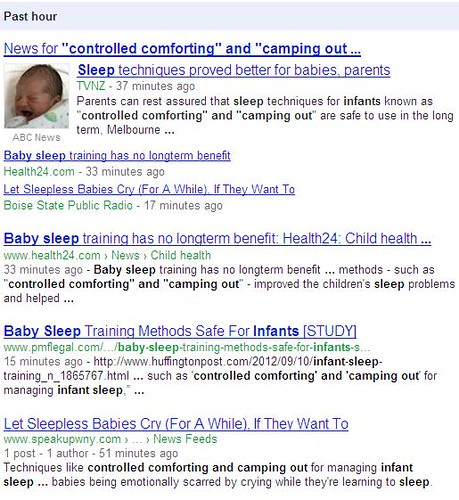
Below is a link to a fascinating article that came out online five days ago. Maybe you are reading about this news for the first time here. The reality is that there are already 463 sites that are touting this information --  in just 5 days -- my Google search informs me. That is the power of the Internet. Science can inform parenting practices. There is tremendous curiosity about how to be effective with children. Infant mental health need not be considered an esoteric subject. Its truths are of interest to the general public. -gw 
A new study by researchers from Murdoch Childrens Research Institute claims that "controlled comforting" and "camping out" (behavioral sleep technique) not only helps infants sleep better, it also reduces depression levels in mothers.Researchers, who conducted the first ever study of its kind to have looked into the long term effects of these sleep techniques, say they are safe to be used in the long-term.

Tuesday, August 14, 2012

On Infant Mental Health Intervention For Preterm Infants in Japan: Promotes maternal mental health and mother-infant interactions


There are formal infant mental health programs in place in countries all around the world. In this example, Japan. -gw
 
Abstract
 
The aim of this study was to investigate the effectiveness of the Japanese Infant Mental Health Program (JIMHP) for preterm mother–infant dyads until the infants reached 12 months of corrected age. Mothers in the JIMHP group (n = 26) received one hospital visit in addition to standard care in the Growing Care Unit (GCU) and five home visits based on the principles of infant mental health (IMH) after discharge from the hospital, until the infant reached 12 months of corrected age. In contrast, mothers in the control program group (n = 40) received standard care in the GCU and three conventional home visits during the same period. The dyads were then compared across groups, revealing that the JIMHP dyads showed less maternal depressive symptoms, better maternal interaction, increased social support by medical workers and healthcare professionals, a high persistence rate for attending the program, and a more positive perception toward the program (p < .05). However, there were no significant differences in the impact of parenting stress or in child development. These results are discussed in terms of their significance and the practical/clinical availability of IMH principles and the JIMHP as a new support model for preterm infants in Japan.
 

Monday, August 13, 2012

On Tickling and Teasing: Disrespecting young children

Salishan Children Say Thank You 083
+
"We've all seen this at the beach" -- this month we spend so much time outdoors and in public recreational areas -- "screaming toddlers and preschoolers ... carried to be thrown into the water" to their intense distress. This is not how to play with a child. -gw
+
How does one follow the lead of the child? By respecting that young children need to explore, discover, and construct their own learning and understanding, and by allowing them opportunities to do so.
Adults need to remember that they should not over-stimulate their children. Observation is key. The clearest example of over stimulation is tickling. Kids love to get tickled. But then they reach a point where they become over stimulated and it's no longer fun for them. You have to watch for physical signs and cues that kids have reached their breaking point. Babies will turn their gaze and their bodies away, older kids will say "no," "stop" or "no more." Crying, tantrums, any behavior - even laughing - where the child's emotion is escalated indicates over stimulation. It's just another reason observation skills are so important.
... it’s certainly common for adults or older kids to tease young children unmercifully, to justify their actions by saying they’re “just teasing”, and to become angry and even punish the child who displays distress when teased intensely. School-age children exposed to this treatment usually learn how to evade the adult’s attention, but younger ones naturally respond to distress by approaching the people who ought to be protecting them--  the very ones who are tormenting them.  We’ve all seen this at the beach, as screaming toddlers and preschoolers are carried to be thrown into the water, or in other situations where an adult picks up a child and won’t put her down, or threatens to throw away a toy or harm a pet. These situations often conclude with some type of punishment of the child, who is then characterized as a “wimp” or a “sissy”.

Thursday, July 5, 2012

On Enthralled Babies: Thomas suddenly stopped breastfeeding to join in the singing

I was putting baby Thomas (13 months old) to sleep and was singing our usual bedtime prayer, when Thomas suddenly stopped breastfeeding to join in the singing. 
 
 
A mother's song is far more powerful than any professional musical recording. So the advice to mothers is, sing to your baby. It's good for the brain and does wonders for attachment. The folks at Zero to Three, the National Center for Infants, Toddlers and Families devoted an issue of their journal to the subject. -gw
 
[I]nfant development researchers (known to each other as “baby watchers”) [know] that babies seem to be much more enthralled by their mothers’ singing than by the voice of a trained performer.