 As if there aren't enough ways to keep track tract of what people are doing PCIT-wise on the internet!
 Tuesday, April 28, 2015
On Doing Parent Child Interaction Therapy: In a community mental health setting
As if there aren't enough ways to keep track tract of what people are doing PCIT-wise on the internet! 

Thursday, September 19, 2013
How Everything Fits Together, or Can: The Early Childhood Comprehensive System
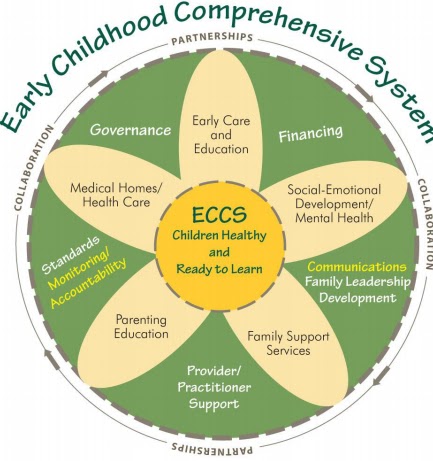
This handy, dandy visual portrays the collaboration and partnerships the comprise on overall comprehensive system to ensure that children are healthy and ready to learn in early childhood.
Early Childhood Comprehensive Systems grants help states and communities to build and integrate early childhood service systems that better meet the needs of children and families. Since 2003, 49 States, the District of Columbia, Guam, the Republic of Palau and the commonwealths of Puerto Rico and the Mariana Islands have participated in the program.b.hrsa.gov/programs/earlychildhood/comprehensivesystems/
On Middle School Is Too Late: Developmental and social risk factors show up in early childhood

More on the importance of early identification of mental and behavioral health problems comes from a study cited in on an article on the Washington Post website. -gw
• Over 70 percent of students diagnosed with mental illness and behavioral health problems by middle school exhibited warning signs by second grade.

• Almost 25 percent exhibited red flags during pre-kindergarten years, including developmental and health issues, adverse social factors and exposure to trauma.
• Twenty-five percent of the children studied had documented traumatic experiences in their records.
Yet it is not until middle school that mental and behavioral health problems are identified, according to educational records of children referred to the Center for Children’s Advocacy, a Connecticut nonprofit that provides legal support for abused and neglected children.http://www.washingtonpost.com/blogs/answer-sheet/wp/2013/09/19/study-impact-of-unaddressed-mental-health-issues-on-students-is-severe/
On Back to Basics: Infant mental health defined
OK, what's infant mental health again? Here is the definition of infant mental health developed by ZERO TO THREE’s Infant Mental Health Task Force.
Zero To Three's Early Childhood Mental Health page is a great place to start finding resources for both parents and professionals. -gw
"Infant mental health" is defined as the healthy social and emotional development of a child from birth to 3 years; and a growing field of research and practice devoted to the:
http://www.zerotothree.org/child-development/early-childhood-mental-health/Promotion of healthy social and emotional development;
Zero To Three's Early Childhood Mental Health page is a great place to start finding resources for both parents and professionals. -gw
Thursday, August 29, 2013
On the Infant Toddler Temperment Tool: Handy tool for understanding adult and child similarities and differences
The Infant Toddler Temperament Tool (IT3) was developed for the Center for Early Childhood Mental Health Consultation, an Innovation and Support Project funded by the Office of Head Start. The Infant Toddler Temperament Tool includes a short online survey that allows parents and caregivers of infants and toddlers to recognize and explore their own temperament traits and those of a child for which they provide care. The IT3 generates results which support parents and caregivers in understanding how adult and child similarities and differences in temperament traits may affect “goodness of fit.” Along with these results, the IT3 generates simple best practice tips adults can use to foster the unique temperament of each child within their care.

Infant Toddler Temperament Tool (IT3)
Handy tool. -gw
To use the IT3 click here:
Tuesday, August 20, 2013
On an Unhealthy Diet's Impact On Externalizing and Internalizing Problems of Your Children: Study results

Here are the results of a study looking at impact of diet on early childhood mental health. -gw
Higher intakes of unhealthy foods during pregnancy predicted externalizing problems among children, independently of other potential confounding factors and childhood diet. Children with a high level of unhealthy diet postnatally had higher levels of both internalizing and externalizing problems. Moreover, children with a low level of postnatal healthy diet also had higher levels of both internalizing and externalizing problems.Maternal and Early Postnatal Nutrition and Mental Health of Offspring by Age 5 Years: A Prospective Cohort Study
Monday, August 19, 2013
On Looking At the Numbers for Early Childhood Mental Health Consultation: Oklahoma in 2012 as an example

It seems helpful to see how other states handle the task of early childhood mental health consultation. It's helpful to look at their numbers. How many centers are served? How many referrals? How many hours of service are provided per referral -- that sort of thing. For example, the average time devoted to each referral in Oklahoma during 2012 was 11.11 hours. That seems quite substantial, enough time that actual behavioral change can occur and be supported -- a reduction in the challenging behavior of the child by changing the behavior of the caregivers and altering the environment. -gw

On Another Way To Put It: Transdisciplinary infant-family and early childhood mental health practitioner
I love generic terms. How is this for one? Transdisciplinary infant-family and early childhood mental health practitioner. Is that you? -gw


They are a group of highly skilled practitioners from multiple health and human service, developmental, and educational disciplines, including early intervention, nursing, occupational therapy, physical therapy, speech and language pathology, special education, human development, audiology, social work, and pediatrics. They provide direct services to pregnant women, infants, toddlers and preschoolers and their families. These practitioners have the most frequent contact with infants and very young children and their families and are the most likely individuals to provide promotion and preventive mental health interventions.http://cacenter-ecmh.org/professional-development/categories/transdisciplinary-mental-health-practitioner-tmhp-and-mental-health-specialist-mhs/
And check this out, the California Training Guidelines and Personnel Competencies for Infant-Family and Early Childhood Mental Health, Revised. It defines the universe of competencies assumed necessary to do the work. -gw
On the Three Surprises for DSM-5 Users: If you work with kids

Do you like surprises? Some people do, some don't. -gw
The first of several surprises: DSM-5 includes only Axis I Disorders. Axes II, III, IV and V are eliminated and replaced by a developmental conceptualization and organization throughout the manual. ...
Another surprise, and most controversial, is the new diagnostic name, Autism Spectrum Disorder (ASD). ...
A third surprise, Disruptive Mood Dysregulation Disorder (DMDD), a new Depressive Disorder, describes children up to age 18 years with “persistent irritability and extreme behavioral dyscontrol”.http://cacenter-ecmh.org/dsm-5-a-concise-review-of-the-changes-with-a-special-focus-on-young-children/
On the Long-Lasting Effects of PCIT: Cited in CHADD publication
Outcomes of parent child interaction therapy: mothers; reports of maintenance three to six years after treatment.Parens maintain skills 3 to 6 years after PCIT treatment? That's long lasting -- and duly noted by National Resource Center on AD/HD, a program of CHADD. -gw
Thursday, August 15, 2013
On Project Launch: Helping children soar
Welcome to the Project LAUNCH Web site. Project LAUNCH, a grant program of the federal Substance Abuse and Mental Health Services Administration (SAMHSA), seeks to promote the wellness of young children birth to age eight. Project LAUNCH focuses on improving the systems that serve young children with the goal of helping all children reach physical, social, emotional, behavioral, and cognitive milestones. This Web site is a resource for Project LAUNCH grantees and others interested in learning about how to promote young child wellness.http://projectlaunch.promoteprevent.org/
Washington State was included in this initiative for 2008. The evidence-based programs that were funded were: Parents as Teachers, Strengthening Multi-Ethnic Families and Communities Program, Incredible Years, Positive Behavior Supports (Iowa Model), and Early Childhood Mental Health Consultation. The existence of the Peninsulas Early Childhood Mental Health Consultation group is the result of a conference that was funded by the last program mentioned, I believe. You can check out the origins of our group in a 2008 initiative described in this blog post. -gw
For children to thrive in school and beyond, it is essential to invest in the physical and emotional health of young children. Project LAUNCH, a grant program of the federal Substance Abuse and Mental Health Services Administration (SAMHSA), seeks to do just that by promoting the wellness of young children birth to age eight. Using a public health approach, Project LAUNCH focuses on improving the systems that serve young children and address their physical, emotional, social, cognitive and behavioral growth.http://ncssle.airprojects.org/events/early-childhood-prevention-project-launch
On Improving Mental Health Care of Young Children In California: Grounded in evidence-based practices

This from WestEd, the "research, development, and service agency [that] works with education and other communities to promote excellence, achieve equity, and improve learning for children, youth, and adults," whose roots "go back to 1966, when Congress funded regional laboratories across the country to find practical ways to improve the education of our nation’s children."
This article examines how the California Center for Infant-Family and Early Childhood Mental Health has developed evidence-based practices that focus on assessing the state of the infant-parent relationship and working with the family in culturally and socially sensitive ways to strengthen it.http://www.wested.org/resources/early-childhood-mental-health-raising-awareness-taking-action/
On $1.25 Million for Early Childhood Mental Health Consultation: In Massachusetts
Massachusetts is investing $1.25 million in grant funds for the Early Childhood Mental Health Consultation Services Program.

Jointly supported by the Department of Early Education and Care (EEC) and the Department of Mental Health (DMH), the program provides “social and emotional development supports for early education programs serving young children,” according to an EEC press release from earlier this summer.
The plan is to boost educators’ “core competencies, skills and abilities to assess children’s social and emotional progress and to respond to children in behavioral distress,” the press release explains. Doing so can help children and families overcome behavioral challenges and also reduce unnecessary suspensions and expulsions in early education and care settings.http://eyeonearlyeducation.com/2013/08/15/improving-early-childhood-mental-health/
What can Washington State learn from Massachusetts' example? - gw
On Planting the Seeds of the Future: Annual KAEYC conference is schedule for February 2014
 The Kitsap Association for the Education of Young Child is holding is annual "Planting the Seeds of the Future" Conference on Saturday, February 22, 2014 from 8 a.m. to 3 p.m. at Olympic College in Bremerton. For over 20 years this conference has supported numerous early childhood educators in meeting the needs of young children. For further information you can contact KAEYC at P.O. Box 5214, Bremerton WA 98312, or via email to hlanoue@ oc.ctc.edu. -gw
Tuesday, July 23, 2013
On Ideas for Child-Parent Activities: Help for parents from Zero-to-Three

Slide source: Sherri Hill, Babies, brains and relationships
Parent-Child Activities that Promote Thinking SkillsSchool Readiness: Birth to Three
- Create an obstacle course. Lay out boxes to crawl through, stools to step over, pillows to jump on top of, low tables to slither under. Describe what your child is doing as he goes through the course. This helps him understand these concepts.
There are so many resources available through Zero-to-Three. Do you subscribe to the Baby to Big Kid E-newsletter?
An e-newsletter that showcases how children learn and grow each month from birth to 3 years. From Baby to Big Kid translates the science of early childhood and offers strategies parents can tailor to their unique family situation and to the needs of their child.http://www.zerotothree.org/child-development/from-baby-to-big-kid/
Monday, July 22, 2013
On Avoiding the Classroom-to-Prison Pipeline: Ending the kick-out mentality

Slide: Cognitive Behavior Therapy Plus conference
A former CPS caseworker expresses regret for families that were disrupted through her actions 30 years ago, when children were removed permanently in the absence of services to teach parenting skills. -gw
As a culture, are we just too punitive to get our vengeful eyes off the offender and onto collateral casualties, like the kids? By removing defective moms as though they didn’t matter, social services endorses the kick-out mentality. The mom is bad, thus disposable. Labeling people “bad” and putting them aside is too simple. It ignores all the connections, the attachments, the context.
As such, automatically removing children from troubled homes is an early-childhood version of the kick-out mentality that leads to the classroom-to-prison pipeline. It demeans how critically important relationships are to kids — all kids, of all ages. Family members are not spare parts.
Friday, July 19, 2013
Looking Beyond the Silo of Our Discipline: A story of a mother's faith restored

Slide source: Sherry Hill, Babies, Brains and Relationships
Another great story to demonstrate the importance of not being stuck in the "silo" of the discipline we were trained in. Barbara Kalmanson PhD is speaking to me here. -gw
...mental health providers are often under informed about the impact of sensory processing, motor development, or communication systems on the social and emotional development of the child. Here’s an example from the mental health consultation room. A young mother brings her toddler son for consultation. She is concerned he is on the Autism Spectrum. During the play assessment, the child shows interest in a toy drum. Mom and therapist join his play, each sitting to one side of him. The child bangs on the drum. The therapist captures his interest by holding her hand in the air and exaggerating a look on her face that signals high affect anticipation. With the therapist’s support, Mom tries the same gesture and facial expression, but the child only looks in the therapist’s direction. Mom’s facial expression sinks into depression. The therapist, informed by sensory processing differences, as well as psychological processes, sees Mom’s face and checks on her perception. Mom thinks the child prefers the therapist to his own mother. The therapist empathizes with her worry but also conjectures that it might have to do with his visual – motor systems. What if he prefers to look to the right? She has Mom switch places with her on the floor, and low and behold, the child only looks toward the mother. The mother’s faith in her capacity to engage her child is restored and the treatment can proceed by noticing the individual difference needs of her son, and how the parents can build engagement and intimacy in the relationship.
Implementation of principles of infant mental health across disciplines
Thursday, July 18, 2013
On Seeking Pleasure/Avoiding Pain or Designed for Connectedness: Theories about human nature
Which story about our "human nature" do you prefer? Are we in this world out of self-interest, or are we designed for connectedness and relatedness? -gw


On Understanding Violence in America: Quotable quotes from an infant mental health specialist

Keep your eye peeled and you'll discover so much in the news about infant mental health. -gw
"It's sort of like the best kept secret of why I think America is so violent,” she says. “It's because we really don't take good care of our children at a policy, national level."
"So, if we can first admit as a society that infants and toddlers are adversely effected by their experiences,” she says, “and sort of not protect ourselves from the pain of that, then we can begin to look at public policy, funding and training that can alter the course."University of Michigan researcher and infant mental health specialist Julie Ribaudo
On Murder Rates Are Down For Youth: Is it chance or programs that have been shown to work?


Those of us in the field of early childhood typically see the work as so hopeful because effective early intervention can stave off disaster. A young child becomes a teenager and then an adult in what seems like the blink of an eye. Murder rates are down for youth. To what can we attribute the success? Chance? Or programs that have been shown to work?
The CDC, other researchers and partners over time have evaluated different approaches to reducing risk for violence. These types of approaches do reduce risk for violence,” she said. “There is no one reason a young person gets involved with violence. There is no one prevention approach that solves this problem.”
Programs that have been shown to work give youngster better communication skills, encourage parents to be more involved in what their children are doing, and discourage violence in general. Not all programs do work, Ferdon noted. “What we have seen is there is a lot of variablility in these programs,” she said.
She said the Center for the Study and Prevention of Violence at the University of Colorado outlines some, which include intensive family counseling such as parent-child interaction therapy; multisystemic therapy aimed at homes, schools and neighborhoods; and cognitive-behavioral group therapy.http://www.nbcnews.com/health/youth-murder-rates-30-year-low-cdc-reports-6C10604586
The Incredible Years and violence prevention
Subscribe to:
Posts (Atom)